
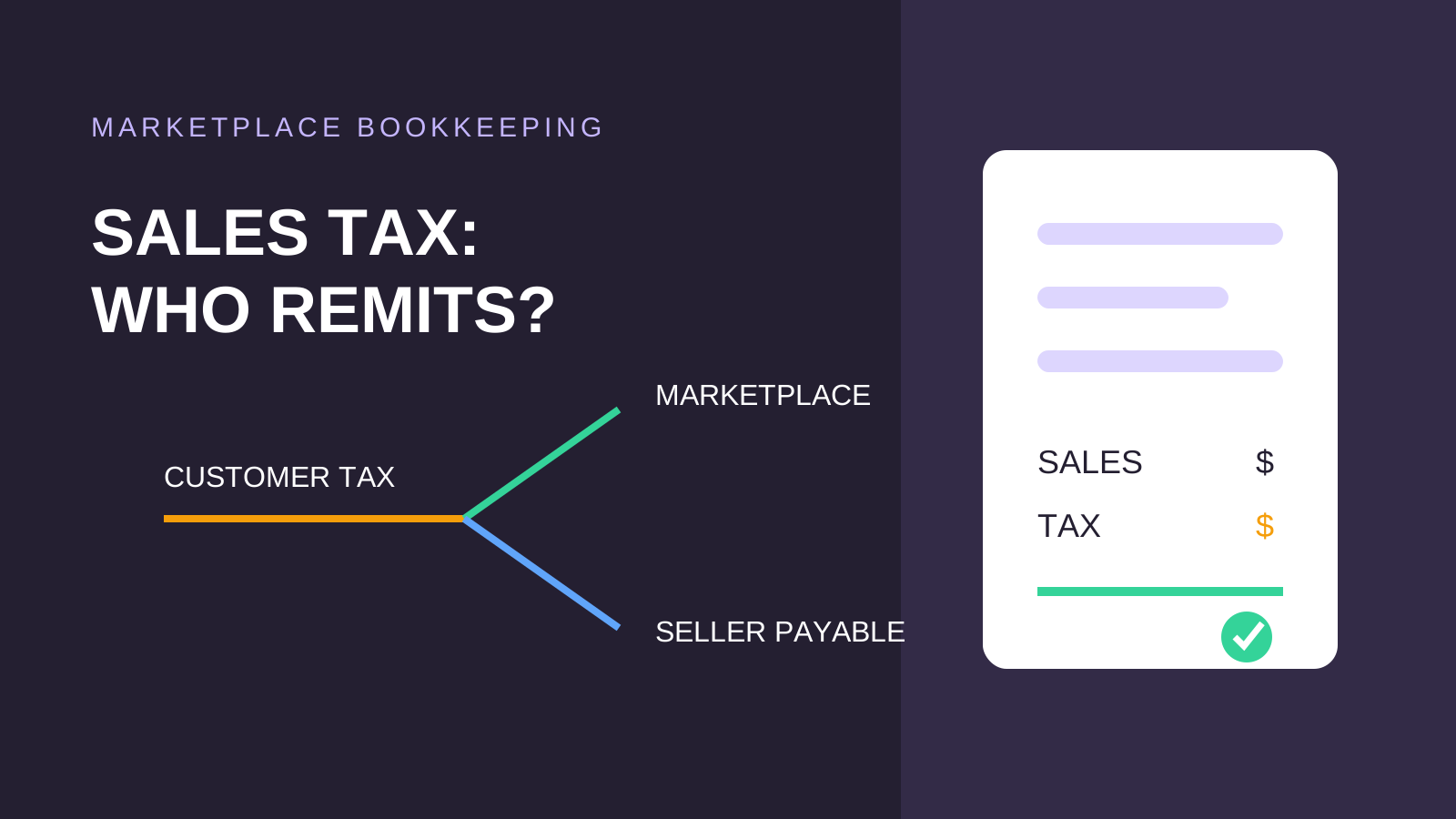
Top summary
Direct answer: Separate marketplace-remitted tax from tax your ecommerce business must remit, record revenue without a false marketplace-tax payable, preserve jurisdiction-level gross-sales evidence, and reconcile platform reports, direct-channel liabilities, returns, and filings every period.
- The platform report can display tax that never entered the seller’s cash.
- Legal collection responsibility, financial-statement presentation, and state-return reporting are three separate questions.
- A channel-jurisdiction matrix prevents one marketplace rule from being applied to direct website sales.
Who is this for, and what decision should it complete?
This guide is for a US ecommerce founder or finance operator selling through marketplaces and a direct store. The decision is how to record customer tax shown in orders when a marketplace facilitator collects and remits some amounts, while the seller collects and remits others. The goal is a clean sales-tax payable and a filing-ready audit trail, not a legal determination for every state.
Search results often answer either “the marketplace handles it” or “credit a sales-tax liability.” Both can be incomplete. State rules may still require sales reporting, platform exports may show informational tax, and direct-channel obligations remain. This article connects order data, cash, liability, marketplace responsibility, and return reporting.
What data must be separated before posting?
Build a transaction population by legal entity, channel, ship-to jurisdiction, order date, tax type, taxable sales, exempt sales, tax charged, collector, remitter, refund, and payout. Preserve marketplace reports that identify facilitator tax and the agreement or certificate supporting the marketplace’s responsibility.
Do not infer remitter from the bank deposit. A platform may show gross customer tax in an order report and remove it before settlement. Conversely, a direct payment processor may transfer collected tax to the seller without assuming any filing responsibility. Payment processing and marketplace facilitation are not interchangeable.
How does the responsibility classification tree work?
This is the first original-value component.
- Who made or facilitated the sale? Identify marketplace versus direct store and the contractual seller.
- Does current jurisdiction guidance place collection and remittance on the marketplace for this transaction? Verify with the state and platform evidence.
- Did the marketplace actually collect the correct tax? Exceptions and bad product or address data can shift exposure.
- Did the seller ever control the tax cash? Trace settlement lines rather than assuming.
- Must the seller report facilitated sales on its return? Reporting can remain even when remittance does not.
- What evidence relieves the seller? Retain certificates, agreements, reports, and records required by the jurisdiction.
Classify each channel-jurisdiction pair as marketplace remits, seller remits, no collection obligation identified, or specialist review. Recheck when nexus, platform status, products, or state law changes.
What are the two acceptable bookkeeping patterns?
A net pattern records seller revenue and excludes facilitator tax from both cash and the seller’s tax payable when the seller never controls the amount and the marketplace bears responsibility. A gross-and-clear pattern records the informational tax in a dedicated marketplace-tax clearing account and clears it against the marketplace remittance/deduction line in the same controlled process.
Either pattern must avoid overstating revenue, cash, expenses, or liabilities and must preserve data needed for returns. Do not credit the ordinary seller sales-tax payable and leave it outstanding when no seller payment will clear it. Consistency, materiality, software constraints, and the applicable accounting policy should guide the choice.
How should the channel-by-jurisdiction matrix be designed?
The second original-value component is a matrix that assigns ownership of each control.
| Population | Collector/remitter | Book treatment | Return evidence | Main risk |
|---|---|---|---|---|
| Marketplace facilitated | Marketplace, when law and facts support | Net or gross-and-clear; no lingering seller payable | Marketplace report and required return line | False liability or omitted gross sales |
| Direct website | Seller where obligated | Credit seller sales-tax payable | Jurisdiction sales and tax detail | Undercollection or missed nexus |
| Exempt sale | Depends on channel | No tax; retain exemption support | Certificate and reason | Invalid certificate |
| Refund | Original responsible party | Reverse consistently with original flow | Refund and tax adjustment report | Seller claims tax it never remitted |
| Platform exception | Unclear or incorrect | Hold in exception clearing pending review | Ticket and state guidance | Unrecorded exposure |
Keep direct and facilitated sales visible even if both flow through one commerce platform. A storefront provider can host multiple payment or marketplace arrangements, and tax responsibility may differ by transaction.
Worked hypothetical example: marketplace and direct sales in one month
Hypothetical example—not a customer result. Assume a seller has $70,000 of marketplace product sales. The marketplace charges customers $5,600 of sales tax, keeps and remits that tax, deducts $7,000 of fees, and pays the seller $63,000. The seller also has $30,000 of direct taxable sales, collects $2,400 of sales tax, suffers $600 of payment fees, and receives $31,800 in cash.
| Flow | Revenue | Seller tax payable | Fees | Cash |
|---|---|---|---|---|
| Marketplace | $70,000 | $0 under stated responsibility assumptions | $7,000 | $63,000 |
| Direct store | $30,000 | $2,400 | $600 | $31,800 |
| Total | $100,000 | $2,400 | $7,600 | $94,800 |
For the marketplace flow, the $5,600 customer tax is retained in the tax evidence but does not become revenue or a lingering seller payable under these assumptions. For the direct flow, debit cash $31,800 and payment fees $600, credit revenue $30,000 and seller sales-tax payable $2,400. When the seller remits the direct tax, debit the payable and credit cash.
Interpretation: crediting a $5,600 seller payable for marketplace tax without a clearing entry would overstate liabilities. Omitting the $70,000 facilitated sales from every filing workpaper could also be wrong where a state requires those sales to be reported. Limits: no returns, exempt sales, local taxes, timing differences, or platform errors are included. State-specific filing instructions control.
Which mismatch should be investigated first?
- Marketplace tax sitting in the seller-remitted payable after close.
- Tax collected on direct orders with no jurisdiction liability or filing mapping.
- Negative tax, refunds, or adjustments without the original transaction.
- Platform-facilitated sales missing from filing workpapers where reporting is required.
- Tax rate or product-taxability exceptions concentrated in one SKU or address.
- Cash received for tax that the books treated as marketplace-remitted.
- Marketplace certificates or responsibility documents missing or expired.
Prioritize cash-controlled amounts, delinquent jurisdictions, material rate errors, and missing evidence. An informational report mismatch is lower risk than tax collected by the seller but absent from its payable.
What steps produce a filing-ready reconciliation?
- Freeze order, tax, refund, settlement, and general-ledger data for the period.
- Map each transaction to entity, channel, jurisdiction, collector, and remitter.
- Verify marketplace responsibility against current primary guidance and platform documents.
- Post facilitated tax using the approved net or gross-and-clear method.
- Roll forward seller-collected tax by jurisdiction: opening liability plus tax collected minus refunds and payments.
- Reconcile gross, taxable, exempt, and facilitated sales to filing workpapers.
- Compare filed returns and payments to liabilities; record timing items separately.
- Resolve exceptions and retain certificates, reports, returns, and approvals.
Definition of done: seller-collected tax ties to jurisdiction liabilities and payments; marketplace tax creates no unexplained payable; gross sales bridge from channels to returns; and every material exception has documented ownership.
What common failures create false balances or filing risk?
Recording every displayed tax amount as seller liability creates balances that never clear. Treating all marketplace tax as an expense understates profit. Netting marketplace fees against revenue hides the revenue-to-cash bridge. Assuming a marketplace arrangement covers a direct web sale can omit a liability. Failing to report facilitated sales where required can make returns incomplete even when no tax is due from the seller.
Rules differ by state, locality, product, customer, and business presence and change over time. Marketplace relief may depend on accurate seller information and retained evidence. This guide is a bookkeeping control framework, not a nexus study, taxability opinion, registration decision, or return instruction.
When does this need a sales-tax professional?
Seek qualified advice for new nexus, registrations, delinquent filings, audits, platform errors, mixed direct and marketplace channels, exemptions, digital goods, bundled products, local home-rule jurisdictions, acquisitions, or material prior-period balances. Do not reverse a tax liability merely because a marketplace name appears in the order.
Caigeek can use order, tax-engine, platform, settlement, bank, general-ledger, and return data to produce a channel-jurisdiction matrix, sales-to-filing bridge, liability roll-forward, exception register, and journal support. A qualified tax adviser determines legal obligations and filing positions.
Self-check before sign-off
- Every channel and legal entity is mapped.
- Marketplace responsibility has current evidence.
- Direct tax cash is in the seller payable.
- Facilitator tax leaves no unexplained liability.
- Refunds follow original responsibility.
- Gross sales reconcile to filing workpapers.
- Returns, payments, and GL balances tie.
Sources and last updated
Last checked: 19 August 2026. State guidance is time-sensitive and must be rechecked for the seller’s facts.
- New York State Department of Taxation and Finance, marketplace sales tax requirements
- California Department of Tax and Fee Administration, Marketplace Facilitator Act guide
- Washington Department of Revenue, marketplace facilitators
- North Carolina Department of Revenue, facilitator and seller FAQs
- Michigan Department of Treasury, marketplace facilitator FAQs
FAQ
Is marketplace-collected sales tax the seller's revenue?
Usually it should not inflate seller revenue when the marketplace is responsible and the seller never controls it, but facts and policy matter.
Should marketplace-remitted tax create a seller liability?
No lingering payable should remain for tax the marketplace is responsible for remitting; use a controlled net or clearing method.
Must marketplace sales still appear on state returns?
Sometimes. Requirements vary, and some states specify reporting even when the marketplace remits the tax.
What evidence proves marketplace responsibility?
Retain agreements or certificates, jurisdiction reports, order tax data, settlements, filed returns, and reconciliation workpapers.